AI in B2B marketing - the invisible pre-qualifier
Short AI in B2B marketing is not the chatbot on the website. It is the invisible layer behind lead qualification, offer creation and reporting. Three workflows deliver the fastest ROI: lead scoring with routing, automated first-draft offers, reporting dashboards from multiple sources. Realistic savings: 8 to 16 sales hours per week, payback in 4 to 8 months.
Table of contents 10 sections
- 01Why B2B marketing automation works differently from B2C
- 02Lead qualification: what AI does better than scoring rules
- 03Lead routing: hot lead direct, cold lead into nurture
- 04Offer process: automate standard, keep special human
- 05Sales reporting: from Excel hell to live dashboard
- 06What you should not automate B2B-specifically
- 07Realistic 90-day implementation plan
- 08Practical case: B2B service provider with 18 employees
- 09Frequently asked questions about AI in B2B marketing
- 10Bottom line: AI as pre-qualifier, not as replacement
In B2B marketing, AI is not the robot in chat. It is the invisible pre-qualifier that gives sales 80 percent of their time back. Anyone working in B2B sales knows the problem: 30 inquiries come in, 4 are serious, the rest needs research, qualification, routing. That is where the lever sits.
At Nordsteg we have been working with automated marketing systems in client projects since 2018, and we build AI-supported lead pipelines for Styrian, Carinthian and Viennese B2B providers continuously. This article shows where the ROI sits in B2B and which four areas have to stay human.
Why B2B marketing automation works differently from B2C
Anyone who knows B2C marketing automation thinks first of mass newsletter flows, abandoned-cart emails, cross-sell campaigns. In B2B that does not work. The base parameters are shifted.
B2B has longer decision cycles: Where a B2C customer buys after 30 minutes, a B2B committee needs 30 days to 18 months. Automation has to consider that timeframe rather than optimize for instant conversion.
B2B has higher order values: At 50,000 euros order volume, a lost lead is more expensive than at 50 euros. Mis-routed premium lead, automated email with a typo, generic answer to a specialist question - each costs five-figure money in B2B.
B2B buyers research more deeply: Where B2C is often impulse buying, a B2B purchaser compares five vendors, reads whitepapers, requests references. Marketing has to deliver material that builds trust, not just generates clicks.
These three differences shape where AI makes sense in B2B and where not. Mass newsletter optimization rarely brings the lever in B2B. Lead qualification with real sales routing very often does.
Lead qualification: what AI does better than scoring rules
Classical lead scoring works with manual rules. Point for industry, point for company size, point for email open. The problem: rules are defined once and age.
AI scoring learns from real conversion data. Which combinations of company traits, behavioral signals and inquiry content actually lead to customers? That answer changes over time, with the market, with the offer. A model can track that, a static rule table cannot.
Which signals AI scoring uses
Static signals: Company size, industry, region, approximate revenue (from enriched data).
Behavioral signals: Which pages visited, how long, which whitepapers downloaded, which emails opened, which content depth consumed.
Inquiry signals: Content of the first inquiry (short question vs. detailed description), preferred delivery timeframe, budget hint, whether the decision-maker asks directly or an employee does.
Time signals: Time of day of the inquiry, weekday, latency between first website visit and inquiry.
External signals: Company growth from public sources, job postings (often signal strategic plans), recent news about the company.
The combination of these signals produces a more precise picture than any manual rule table.
When AI scoring does not pay off
Too few historical conversions: Below 200 closed deals, the data foundation is missing. The model finds no stable patterns and optimizes on noise.
Very long sales cycles: When conversions only happen after 12+ months, the training feedback loop is too slow. Classical scoring with manually adjusted rules often works better here.
Highly fluctuating offer: Anyone rebuilding their product portfolio every 6 months has constantly shifting conversion patterns. The AI model cannot keep up; classical rules can be adjusted faster.
Which workflows we concretely build with Make.com and n8n we describe in detail in the GDPR workflow post.
Lead routing: hot lead direct, cold lead into nurture
A qualified lead is only half the win. Only the right routing turns it into conversion. Many B2B setups fail here: lead is classified as "hot" but lands in the sales inbox among 50 other emails and is processed only after three days.
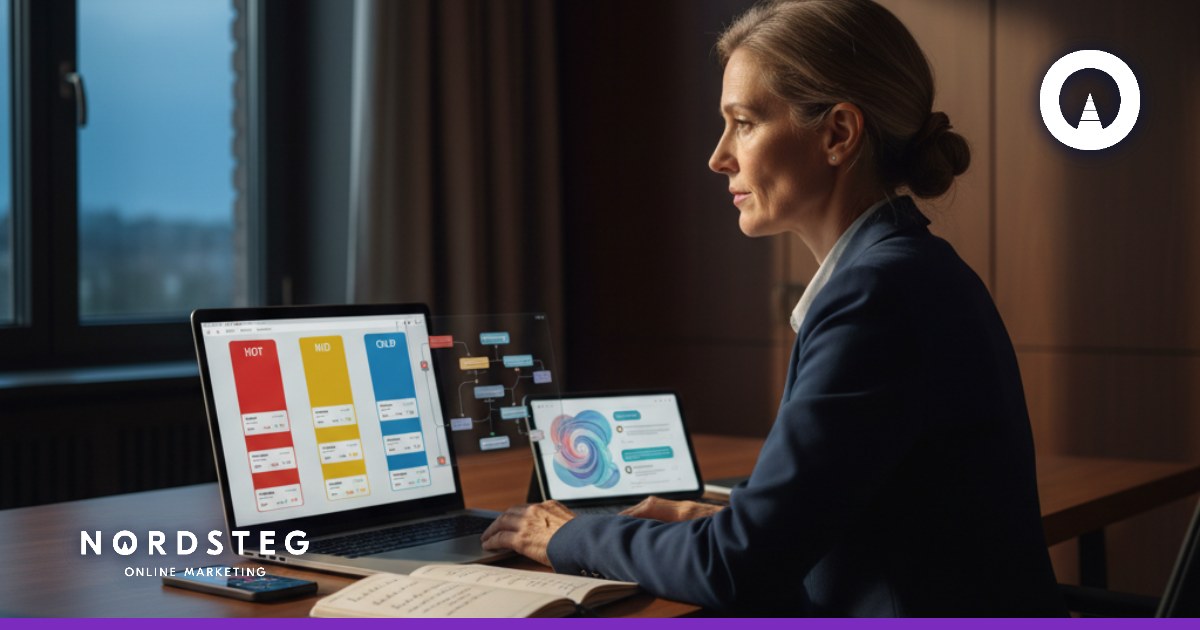
Hot lead - score above 70: Immediate Slack notification to the sales rep responsible for the region. Lead status set to "MQL hot" in CRM. Phone number shown if available, with click-to-call link. Expected response slot: 60 minutes during business hours.
Mid-range lead - score 40 to 70: Automated confirmation email with appointment booking link. Three-step nurture flow over 14 days with relevant content. On appointment booking, escalation into hot status.
Cold lead - score below 40: Confirmation email with pointer to self-service resources (whitepapers, FAQ). Added to the monthly newsletter list. Re-scoring after 90 days if new behavior is registered.
Spam or off-topic: Automatically marked as "disqualified" with reason. Sales does not see it. Important: monthly sample review so real leads do not get filtered out by mistake.
What often goes wrong in routing
Sales territories ignored: Hot lead gets routed to the wrong team. Solution: postal code mapping as mandatory layer in routing.
Vacations not considered: Hot lead lands with an absent rep. Solution: deputy logic in routing, automatic absence detection from Outlook calendar.
Duplicate contacts with existing customers: Lead was already in CRM, comes in again as a new lead. Sales finds out only on the call. Solution: mandatory duplicate check in the workflow.
Offer process: automate standard, keep special human
In most B2B vendors, 60 to 80 percent of offers can be clustered into standard variants. That is the zone where AI lifts efficiency.
What can be partly automated
First draft of the offer: AI generates a first offer draft based on the inquiry and CRM data, with standard line items, typical prices, common terms. Sales reviews, adjusts, approves. Instead of 60 minutes of manual work, 15 minutes of review time remain.
Standard clauses and variants: Terms and conditions, payment terms, delivery terms - templates with configuration logic. AI picks the right variant based on customer classification.
Cross-sell suggestions: Which additional products fit this inquiry? Which add-ons are often picked on comparable inquiries? Feed those suggestions into the first draft.
Offer dispatch and tracking: PDF generation with personalization, dispatch with tracking (when opened, how long viewed, forwarded to whom). That data flows back into lead scoring.
What stays human
Negotiation room on premium deals: Above 25,000 euros order volume, the person decides, not the system. Sales should have room to adjust terms, reach special agreements.
Complex special inquiries: Inquiry does not fit the standard grid. AI flags it, human takes over. The detection is what matters, not the automatic processing.
Binding commitments: Even when the offer is generated automatically, approval has to be human. Otherwise commitments arise that nobody reviewed.
Sales reporting: from Excel hell to live dashboard
In many B2B vendors, monthly reporting eats three to five sales hours. Copy data from CRM, reconcile with marketing data from GA4, connect with order data from ERP, all into an Excel sheet, then a presentation for leadership.
These layers are perfect for automation.
What good B2B reporting covers
Pipeline overview: Number of leads per stage, velocity (how fast leads move through stages), bottlenecks (where do leads get stuck).
Conversion metrics: Lead-to-MQL rate, MQL-to-SQL rate, SQL-to-customer rate. If a stage drops, it becomes visible immediately.
Source analysis: Which marketing channel delivers what order quality? Not only count, but order value per source. Often the most valuable insight for budget decisions.
Sales performance: Which rep closes which deals in which time? Important: not for evaluation, but for learning. The faster ones can show the slower ones what works.
Forecast vs. reality: Where was the forecast 30 days ago, where does reality stand today? Which deals are behind, which surprisingly fast?
What is often missing in reporting setups
Definition of what counts: What exactly is an "MQL"? What is a "qualified lead"? These definitions need to be written down, otherwise the tool calculates incorrectly.
Data quality safeguards: If the sales rep does not maintain lead status, reporting is garbage. Maintaining the data discipline is part of the reporting setup.
Access rights: Who sees what? Leadership sees everything, sales team only their pipeline, marketing only marketing KPIs. Otherwise mistrust or comparison pressure arises.
What you should not automate B2B-specifically
Four areas are particularly sensitive in B2B. Automation here destroys more than it builds.
First conversations with premium leads
Above 25,000 euros order volume: Here the first conversation decides the entire relationship. Generic reply emails, automated appointment suggestions without context, confirmation sequences that smell of standard - all trust killers. Premium leads need the personal answer within 60 minutes, written or spoken by a person with context to the inquiry.
Complex negotiations
Special terms, custom contract design, unusual delivery requirements: These topics need negotiation room that cannot be algorithmized. Anyone automating that loses options an experienced rep would use.
Crisis communication
Complaints, delivery issues, service outages: Here a human has to answer, as fast as possible, as personal as possible. Automated "we are looking into it" emails amplify frustration. An escalation logic in the workflow is fine, the content of the answer must be human.
Relationship management with strategic partners
Personal congratulations, recommendations, individualized updates to top customers: As soon as the relationship carries the content, automation is the relationship killer. Better rare and personal than frequent and automatic.
Realistic 90-day implementation plan
Anyone wanting to build AI-supported lead pipelines in B2B should do it step by step. A 90-day plan that has proven itself in our projects.
Days 1 to 14 - foundations: Tracking audit, CRM cleanup, define mandatory fields, involve sales team, fix conversion definitions in writing.
Days 15 to 30 - workflow 1: Lead capture with automated CRM entry and anti-spam layer. Start classical scoring (rule-based). Implement sales routing.
Days 31 to 60 - workflow 2: AI scoring based on the first data from workflow 1. At least 30 days of observation before AI scoring goes live. Comparison against rule scoring.
Days 61 to 90 - workflow 3: Offer first drafts and automated reporting. The efficiency peak is reached here. Sales gains back 8 to 16 hours per week.
Stick to that order and you build a stable system. Start all three workflows at once and you get three half-finished systems instead of one productive.
Practical case: B2B service provider with 18 employees
Anonymized example from active engagement. Styrian B2B service provider with 18 employees, 4 in sales, 2 in marketing.
Starting position: 80 to 120 inquiries per month via web form and email. Sales spends 90 minutes daily on initial review and research. Response time on qualified inquiries: 6 to 24 hours. Inquiry-to-appointment conversion rate: 12 percent. Appointment-to-deal conversion rate: 35 percent.
Setup over 60 days:
- Days 1 to 14: tracking audit, CRM cleanup (1,200 duplicates found and merged), mandatory fields defined.
- Days 15 to 30: lead capture workflow live with anti-spam and rule scoring. Anti-spam catches about 30 percent of inquiries.
- Days 31 to 60: AI scoring activated based on the first 600 real leads. Routing logic by region and product area.
Setup costs: 11,500 euros for concept, implementation, training. Tools running 320 euros per month.
Result after 90 days of live operation:
- Sales effort for inquiry triage: from 7.5 to 1.5 hours per week per rep
- Response time on hot leads: from 6-24 hours to under 30 minutes
- Inquiry-to-appointment conversion rate: from 12 to 19 percent (+58 percent)
- Appointment-to-deal conversion rate: from 35 to 38 percent (slight increase due to better pre-qualification)
Payback math: Gained sales time 6 hours per week per person × 4 people × 80 euros × 4 weeks = 7,680 euros monthly value plus conversion lift. Setup costs 11,500 euros paid back in 1.5 months.
What unexpectedly came up: Sales team needed 6 to 8 weeks to adjust. Some reps were skeptical of lead scoring ("the algorithm misses my special customers"). Solution: all AI scoring decisions stayed transparent, manual override always possible. After three months acceptance was high.
What did not work: First version of offer first drafts was too generic. Two iterations with better prompts and more context data were necessary. Today the workflow saves 25 to 40 minutes per offer.
A detail worth knowing: The invisible effect was often bigger than the measurable. Sales team reported that day planning had become much calmer. Instead of having to go through inquiries in the morning, that was already done. The first two hours of the workday went directly into strategic customer conversations. That effect did not show up in any time statistic, but for leadership it was a central argument for the project.
Anyone looking for a broader structural marketing plan will find one in the 90-day plan book. The routines work without AI - and become better with AI.
Frequently asked questions about AI in B2B marketing
What does AI really deliver in B2B marketing?
In B2B marketing, the biggest AI lever sits in lead pre-qualification, semi-automated offer creation and reporting. Realistic numbers: 60 to 80 percent time savings on lead handling and 30 to 50 percent faster offer turnaround. What AI does not replace: personal first conversations, trust building, complex negotiations.
How does AI-based lead scoring work in B2B?
AI lead scoring combines manually defined rules (company size, industry, region) with behavioral data (web visits, email opens, content consumption) and external signals (firmographic enrichment). The model learns from historical conversion patterns which combinations turn into real customers. Result: sales gets only the hot leads, cold ones go into nurture.
Which B2B processes should NOT be automated?
Four areas stay human: first conversations with premium leads above 25,000 euros order value, complex negotiations with custom terms, crisis communication on complaints, personal relationship management with strategic partners. Automating those damages trust faster than any efficiency gain justifies.
How quickly does AI in B2B marketing pay back?
For a typical B2B SMB with 30 to 100 inquiries per month, an AI lead setup with 8,000 to 15,000 euros setup cost pays back within 4 to 8 months. The math comes from saved sales time (8 to 16 hours per week) and a higher conversion rate (15 to 30 percent increase).
Which tools fit B2B lead automation?
Proven stack for B2B SMBs: HubSpot or Pipedrive as CRM anchor, Make.com or n8n for workflow orchestration, OpenAI or Claude for AI scoring, Brevo for email automation, Slack for sales notifications. Larger B2B vendors often add a lead enrichment tool such as Clearbit or Dealfront.
How much sales time can realistically be saved?
In practice we see 8 to 16 hours per week saved per sales rep through AI pre-qualification. At a 5,000 euros monthly salary that equals 1,000 to 2,000 euros per month. Important: the saved time has to flow into higher-value work, otherwise the effect is only on paper.
Bottom line: AI as pre-qualifier, not as replacement
AI in B2B marketing does two things really well: it filters spam and cold inquiries, and it prepares standard tasks. What it does not do: replace human sales. In B2B, nobody buys from an algorithm. People buy from people they trust.
Anyone using AI as pre-qualifier wins back 8 to 16 hours per week for sales - time that flows into real conversations, relationship building and deal closing. That is the actual lever: not less human sales, but more human sales with the right leads.