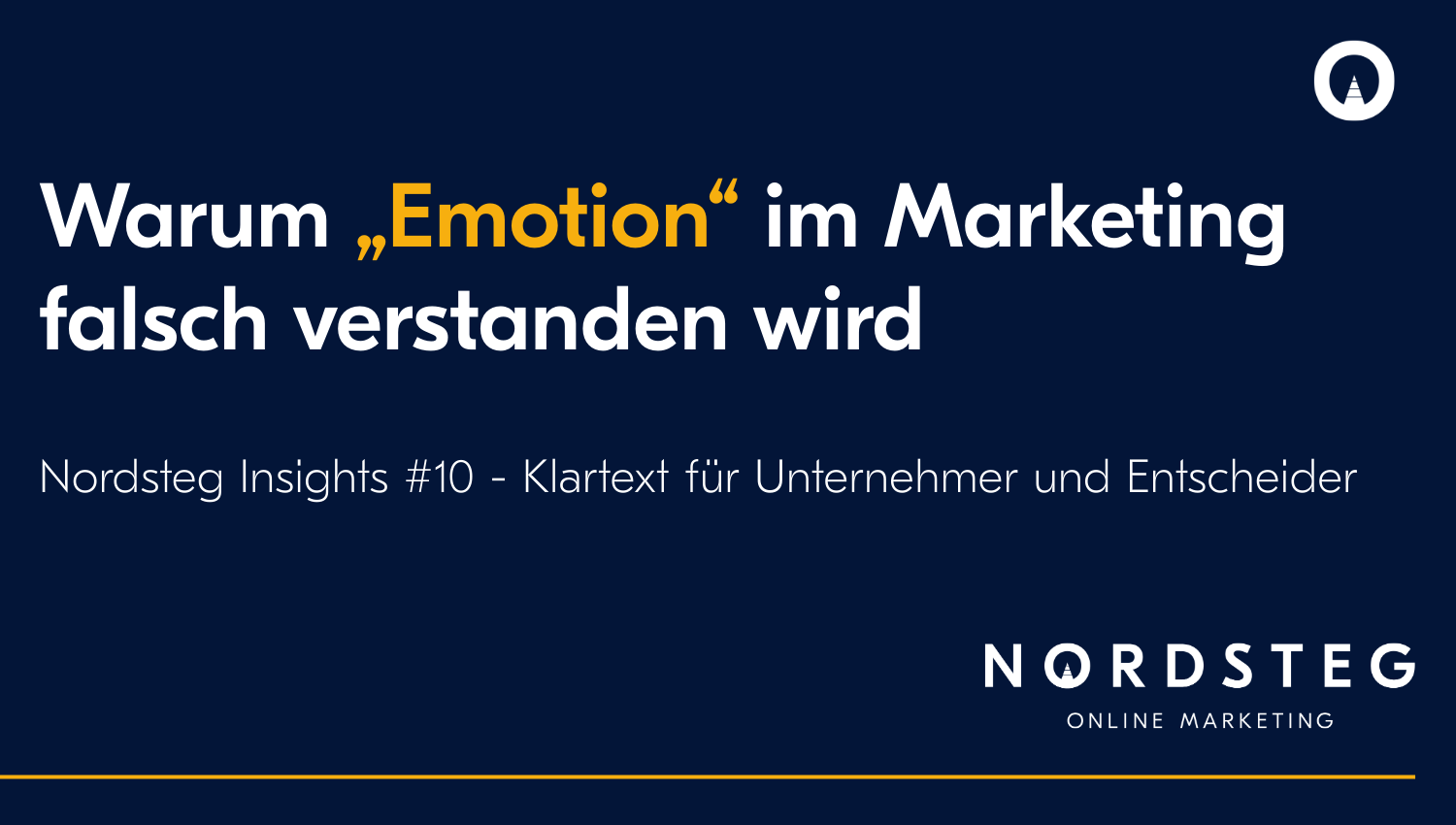
Why 'Emotion' in Marketing Is Misunderstood
1. The blind spot
Marketing has treated emotion as one big bucket.
Table of contents 6 sections
Anything not rationally explainable was simply called "emotional".
The effect:
Companies build campaigns that entertain - but do not work.
They touch people - but do not move them.
They generate attention - but no memory.
A feeling alone sells nothing.
Because the brain decides differently from how we think.
2. Typical symptoms in companies:
- Campaigns generate reach but no enquiries
- Customers remember the story but not the brand
- Creativity outshines the message
- Brand messages get lost in the entertainment
This is not a creative problem. It is a structural problem.
When we call everything "emotion", we overlook the mechanics in the brain that actually create impact.
3. Emotion = 3 things
Neuromarketing - in particular the work of Pranav Yadav - shows a much clearer order:
"Emotion" is not one factor. It is three - and they do not work the same way.
- Relevance - the filter
- Memory encoding - the storage
- Emotional intensity - the amplifier
And their order is non-negotiable.
Relevance decides whether something gets into the brain. Memory encoding decides whether it stays there. Emotion decides how strongly it works - but only if the first two are right.
The industry has, for decades, started at point three - and wondered why nothing happened.
4. Solution - the Neuro-Clarity framework
When a company builds marketing that works, it follows this structure:
1. Establish relevance - "Is this important to me?"
The brain is efficient.
It stores nothing that has no personal relevance.
Relevance comes from clarity: goal, problem, benefit - in one sentence.
Principle:
Without relevance, no memory. Without memory, no revenue.
2. Secure memory encoding - "Does the brain remember the message?"
The strongest predictor of future behaviour is the brain's ability to store something.
- Not the click.
- Not the time on page.
- Not the emotion.
Storage comes from structure:
- a clear message
- in the right place
- at the right moment of attention
Principle:
The brain doesn't store coincidences - only patterns.
3. Dose emotional intensity - "How strongly does the person experience the moment?"
Emotion amplifies impact - but it does not replace relevance. It makes the experience more intense, more visible, more memorable. Yet if the brand is not present in this peak, it all fizzles. That is the "vampire effect":
- The spot is remembered.
- The joke is remembered.
- The dog in the video is remembered.
- Just not the brand.
Principle:
Emotion is the amplifier. Not the reason.
5. Outlook
The next successful brands will not be the loudest.
And not the most emotional. They will be the clearest.
Companies that think relevance, memory and emotion in the right order will overtake their competition - not through budget, but through structure.
Impact happens when a message is first relevant, then stored and only then emotionally amplified.
Marketing that follows this path works deeper than any creative idea. It builds brands that stay in mind - and influence decisions.
6. Closing
Look at your best campaign of recent years:
Did your customer remember the brand - or only the feeling?
Is your website losing customers?
Our AI scans your website and delivers a professional analysis report - free of charge as a PDF via email.
Request free analysisNicolas Fabjan - Founder & CEO Nordsteg
Plain talk on systems, marketing and the future.