Funnel Checklist: Where Customers Drop Off - and How to Change That
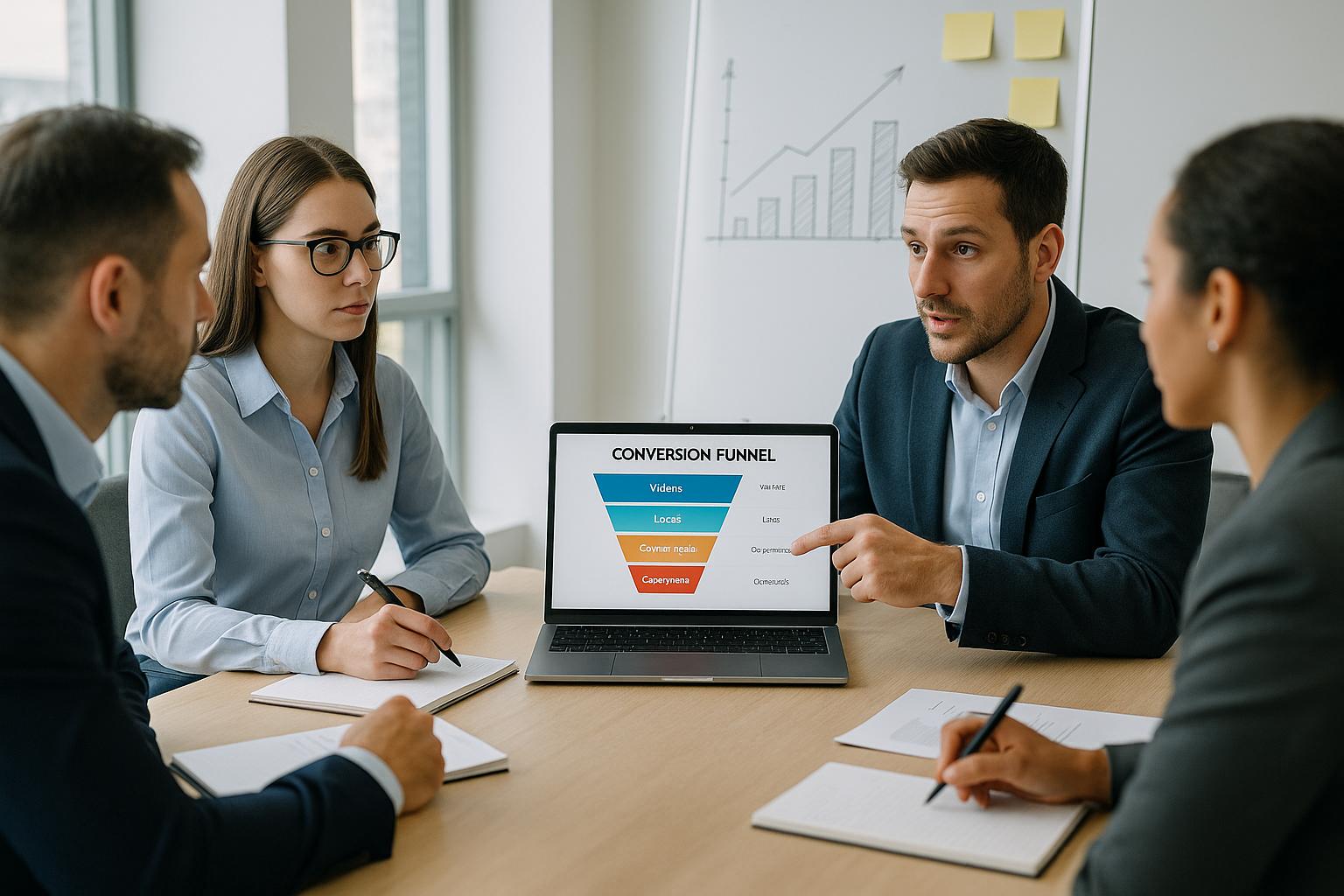
Did you know that many companies waste up to 70% of their marketing budget because their funnel does not function optimally? Without precise analysis, you lose potential customers at every stage of the customer journey. But that can be changed.
Table of contents 6 sections
The solution: specifically identify and fix weak spots in your funnel. With data-driven measures, you can boost your conversion rate and use your budget more efficiently - without additional costs.
Key takeaways:
- Clear target group approach and optimised landing pages prevent drop-offs.
- Simple and transparent ordering processes increase the close rate.
- Follow-up support and remarketing strengthen customer loyalty.
Read on to learn concrete steps to optimise every funnel phase.
Funnel checklist: where customers drop off
A well-functioning funnel is decisive to guide customers through the various phases of the customer journey. But often there are weak spots that scare off potential buyers. Here you learn how to recognise and eliminate these pitfalls.
Awareness stage
The first impression counts - especially in the awareness phase. Your advertising messages must precisely address the needs and expectations of your target group in Austria. Often it fails on a target group approach that is too broad or imprecise. Ads without a local reference feel interchangeable and waste budget.
Therefore use content that addresses your target group directly, and avoid generic messages. Once you have mastered this step, it is about convincing the visitors on your website. More on this in the next phase.
Consideration stage
When prospects visit your website, you have to convince them to stay in the process. Here technical and content aspects play a big role. Long loading times, confusing navigation or poor mobile display often lead to visitors bouncing.
Check whether your landing pages quickly deliver the most important information. You create trust through elements like customer reviews, visible contact options and local references. This way you come across as authentic and reputable.
Conversion stage
In the conversion phase, it is decided whether a prospect actually becomes a customer. Here even small hurdles can have big effects. Complicated ordering processes, unnecessary mandatory fields or unclear pricing scare off many.
Particularly important: a mobile-optimised presentation, as more and more users buy via smartphones. Call-to-action buttons should be clearly worded and well visible. Instead of generic phrasing like "Buy now", specific prompts like "Secure a free consultation" or "Request a no-obligation offer" often work better.
Transparency on shipping costs, delivery times and return terms additionally creates trust and makes the purchase decision easier.
Post-click stage
After the purchase is before the purchase. Many companies neglect follow-up care, yet enormous potential lies here. Automated email sequences can welcome new customers, inform existing customers about new offers or win back prospects who dropped off.
Important is a differentiated approach: new customers need different content than returning buyers. Personalised campaigns are often more effective than generic newsletters. Always consider GDPR requirements.
With targeted measures in this phase, you strengthen customer loyalty - a central approach we follow at Nordsteg.
Tracking and measurement
Without precise tracking, optimisation measures often remain ineffective. Tools like Google Analytics 4 or conversion tracking deliver valuable data about the behaviour of your visitors. Define clear KPIs for every funnel stage to specifically recognise weak spots:
- Awareness: reach and relevant clicks
- Consideration: dwell time and page views
- Conversion: close rate and average order value
- Retention: repurchase rate and Customer Lifetime Value
A well-thought-out tracking system helps you make data-driven decisions and implement targeted improvements. This way you get the best out of your funnel.
How to fix weak spots at every funnel stage
Successful funnel optimisation is based on a clear strategy. With targeted measures, you can efficiently improve every stage of your funnel - from target group segmentation to performance monitoring. Here you learn how to proceed step by step.
Target group segmentation
Many Austrian companies lose valuable budget because they address their target group too broadly. Instead of addressing "all prospects", you should develop specific buyer personas. Criteria like industry, company size and regional focus help align your messages precisely.
Practical approaches for better segmentation:
- Analyse your customer data by relevant factors like industry, size and region.
- Create detailed buyer personas that reflect concrete needs and challenges.
- Develop individual advertising messages and landing pages for every persona.
- Use regional references, e.g. "tax advice in Vienna" or "tradesperson software for Salzburg".
At Nordsteg, we place great importance on a well-founded target group analysis as part of our marketing master plan, to achieve long-term and measurable results.
Landing page improvements
The landing page is often the first touchpoint with potential customers - and within a few seconds decides between success and failure. Local references and trust-building elements are decisive here.
Measures to optimise your landing page:
- Place Austrian contact details well visible (e.g. +43 1 234 5678).
- Integrate customer reviews and references from Austria.
- Use Austrian spelling and terminology.
- Show certifications from domestic associations.
- Improve loading time to ensure a fast user experience.
These measures strengthen the trust of your target group and ensure a higher conversion rate.
Conversion rate optimisation
In the conversion phase, every detail counts. The goal is to minimise hurdles and design the completion process as simple as possible. Particularly appreciated in Austria are additional contact options and flexible payment options.
Proven strategies to boost the conversion rate:
- Reduce form fields to the essentials (e.g. name, email, phone).
- Offer WhatsApp as an additional communication channel.
- Integrate common payment methods popular in Austria.
- Test different call-to-action phrases.
- Use exit-intent popups with special offers.
Examples of effective CTAs in the Austrian market:
- "Arrange a free initial consultation"
- "Request a no-obligation offer"
- "Secure a 15-minute introductory meeting"
- "Get a free analysis"
With optimised checkout processes, you create a solid basis for repeated customer interactions.
Remarketing and follow-up systems
Not every prospect becomes a customer on the first contact. Automated email sequences and remarketing campaigns help address potential customers multiple times and convince them long term.
Strategies for effective remarketing:
- Develop multi-part email sequences for visitors who have left your site.
- Use Google Ads remarketing to specifically address previous website visitors.
- Create exclusive offers for returning visitors.
- Use WhatsApp marketing to enable more direct communication.
- Segment your email lists by behaviour and interests.
Do not forget to comply with GDPR requirements and obtain the corresponding consents.
Performance monitoring
Even the best optimisation measures remain ineffective if they are not regularly reviewed. Set clear KPIs and analyse them continuously to make your successes measurable.
Important metrics for every funnel stage:
- ROAS (Return on Ad Spend): check whether your ad spend is profitable.
- Cost per Lead: keep the cost per lead in view, especially in industry comparison.
- Conversion rate: measure how well your measures perform compared to benchmarks.
- Customer Lifetime Value: especially relevant for subscription models or recurring customers.
Through regular analyses, you can react flexibly to changes and continuously adjust your strategy. This data-driven approach is a central component of our marketing roadmap and ensures sustainable success.
Tools for local funnel analysis
The choice of the right tools decides whether you recognise weak spots in your funnel in time or lose valuable leads. For Austrian companies, it is especially important to choose solutions that are not only technically reliable, but also GDPR-compliant and consider local conditions. In the following, you find proven tools that have turned out to be extremely helpful in practice.
Google Analytics and conversion tracking Google Analytics remains an indispensable basis for funnel analysis. It shows precisely where users leave your website and measures whether defined goals are reached - whether filling in a contact form or downloading a whitepaper. Particularly useful is the geographic segmentation, with which you can, for example, understand whether visitors from Vienna have a higher conversion rate than those from rural regions. This allows campaign and landing page performance to be evaluated specifically.
Important settings for the Austrian market:
- Set time zone to "Europe/Vienna".
- Define local conversion goals, e.g. calls via Austrian phone numbers.
- Use UTM parameters to analyse traffic precisely.
- Set up e-commerce tracking for online sales.
Google Analytics delivers the "what" - for example, which pages are left - but for the "why" behind the numbers you need experienced analysts. The visualisation of user behaviour, as described in the next section, complements this data and offers deeper insights.
Heatmaps and session recordings
While Google Analytics delivers numbers and statistics, heatmap tools like Hotjar show the actual behaviour of your users. These tools make visible where users click, how far they scroll and where they drop off.
Session recordings go even one step further: they let you follow real user sessions step by step. This way you can see exactly how potential customers use your contact form, where they get stuck or why they abandon the process. This information is especially helpful because it also allows conclusions about user expectations and habits.
Practical applications for heatmaps:
- Form optimisation: find out at which fields users abandon.
- Button placement: test whether your calls to action are optimally positioned.
- Content analysis: recognise which areas of your page receive less attention.
- Mobile usability: check the usability of your website on smartphones and tablets.
Make sure these tools are deployed in a GDPR-compliant way. This includes implementing a cookie banner and obtaining user consent.
Nordsteg master plan and roadmap
Technical tools alone are not enough - without a strategic framework, the data gained often remains unused. This is exactly where Nordsteg kicks in: before we start implementing tools, we develop a clear marketing strategy together with you, whether in the form of a master plan or a comprehensive roadmap.
Our approach combines precise data analysis with strategic planning. Instead of short-term experiments, we create a solid basis for predictable results. The marketing roadmap visualises all steps and prioritises measures by their influence on your funnel.
Our offerings:
- Marketing roadmap (€6,990): in a two-day workshop with up to three team members, we analyse your current tool landscape and develop a comprehensive strategy. We consider your budget, technical possibilities and the requirements of the Austrian market.
- Marketing master plan (€1,490): a compact alternative for smaller budgets. You receive four concrete action recommendations that can be implemented immediately and sustainably improve your funnel performance.
With this strategic approach, you avoid implementing tools at random and instead focus specifically on solutions that bring the greatest benefit for your company - that is the Nordsteg path to measurable success.
The Nordsteg approach: why planning comes first
Many entrepreneurs face the same problem: they invest regularly in different marketing measures, but the results remain inconsistent. The reason? There often is a lack of a clear, well-thought-out strategy. Without a strategic foundation marketing quickly becomes gambling.
At Nordsteg we rely on a different approach: first we develop a master plan or roadmap before we start with execution. This way we create predictable results. While many agencies start directly with measures like ads or landing pages, we first analyse the weak spots of your funnels and build a well-founded strategy on top.
Why a solid planning foundation is decisive
The difference between successful and less successful marketing funnels does not lie in the tools or tactics used. Much more important is whether the measures are based on a clear strategy. That is why we start every project with a marketing master plan or a marketing roadmap.
Without this foundation, fragmented funnels often arise: here a new ad is tested, there a landing page optimised - but the measures do not interlock. The result is disconnected actions that do not eliminate weak spots, but often even amplify them.
Our solution? Thoughtful planning that optimises the whole funnel:
- Marketing master plan (€1,490): for smaller budgets, with four tailored action recommendations.
- Marketing roadmap (€6,990): comprehensive, with a two-day workshop for in-depth analysis and planning.
These approaches deliver the basis for all further measures - from Google Ads via SEO through to performance funnels. Instead of isolated single actions, an interlocking system emerges in which every component supports the others.
Clear goals, measurable results
Transparency and measurability are no empty promises with us, but the core of our work. Through strategic upfront planning, we set which metrics are relevant and which results can realistically be reached. We make these targets tangible and assessable through the strategy.
A practical example: companies that work without a clear strategy often spend months finding out why their funnels do not work. With our roadmap, we specifically identify the most important levers and start there. Every optimisation is based on the defined goals and is continuously reviewed.
Our approach can be summarised in three steps:
- Strategy: the master plan or roadmap sets the direction and prioritises measures by their impact on the funnel.
- Execution: measures like Google Ads, SEO or performance funnels are designed to generate customers and revenue long term.
- Optimisation: ongoing adjustments are based on data and the original strategy - not on spontaneous ideas.
This systematic approach creates a decisive advantage: predictable results and sustainable growth. Every test is strategically thought out and contributes to the optimisation of the entire funnel. Short-term experiments are a thing of the past.
By combining strategic planning, data-driven execution and continuous optimisation, we not only create better results, but also lay the foundation for long-term success. This structured approach is the foundation for all further measures in the funnel.
Conclusion: the next steps to funnel optimisation
A successful funnel does not emerge by chance - it is based on precise analysis, careful planning and consistent further development. The most important lesson from this checklist is: without a clear roadmap, optimisation attempts risk going into the void and creating more confusion than solving problems.
The first step is a comprehensive analysis of your funnel. Check every phase - from awareness through to the post-click phase. Identify weak spots and collect relevant metrics. This inventory is the foundation for all further measures that we have previously described in detail.
A well-thought-out strategy connects all touchpoints of your funnel seamlessly. With our strategic planning packages, you secure results that are measurable. A clearly structured master plan helps you find the decisive levers in your funnel and prioritise measures specifically by their impact on your business goals. The result? Sustainable improvements instead of random successes.
Do not wait any longer: start directly with the analysis of your conversion rates in Google Analytics, use heatmap tools and document your insights systematically. Use this data to specifically implement the strategies presented in this article.
Remember: your funnel is only as strong as its weakest point. With a clear strategy and data-driven execution, you create a system that supports long-term growth and reliably delivers results.
FAQs
How do I recognise the weak spots in my funnel and improve the conversion rate?
To uncover weak spots in your funnel and improve the conversion rate, a thorough analysis of the customer journey is needed. It is about examining the individual phases of the funnel precisely to find out where potential customers drop off.
At Nordsteg we rely on long-term strategies based on well-founded foundations. Before we implement measures, we always create a detailed marketing master plan or roadmap. Our goal is to achieve predictable results - through clear strategies and targeted coaching, instead of relying on short-term experiments.
How you can proceed:
- Analyse user behaviour: examine at which phases of your funnel most losses occur. This way you recognise where optimisation is needed.
- Set clear goals: whether you want to boost the conversion rate or use your resources more efficiently - define precisely what you want to achieve.
- Optimise data-driven: use the insights gained to make targeted adjustments and direct your marketing budget to the most effective areas.
A structured approach not only ensures short-term improvements, but also creates the basis for sustainable growth.
Which tools are ideal for funnel analysis in Austria, and how do I ensure they are GDPR-compliant?
For funnel analysis in Austria, several tools are available that can be used GDPR-compliant with proper setup. Matomo is open-source software that gives you full control over your data, especially if you host it on your own servers. Alternatively, etracker and Fathom Analytics offer privacy-friendly solutions because they process data exclusively within the EU.
So that the use of these tools complies with GDPR requirements, you should take the following measures:
- Obtain user consent: use a cookie consent banner to ensure agreement to data collection.
- Activate IP anonymisation: this minimises the processing of personal data.
- Conclude a data processing agreement: agree a legally binding regulation on data processing with the provider.
- Update the privacy policy: add details on the tools used in your privacy policy.
In addition, you should make sure not to collect personal data like names or email addresses to avoid possible data protection violations. This approach helps you minimise legal risks and strengthen the trust of your users.
Why is strategic planning like a marketing master plan or roadmap important for the long-term success of my funnel?
A well-thought-out plan, like a marketing master plan or a roadmap, creates the foundation for long-term success. It brings structure and overview to your marketing and sales processes and helps you specifically recognise potential weak spots in the funnel. This way you can develop measures that systematically turn prospects into paying customers.
By clearly segmenting your leads along the various funnel phases, you tailor your communication and offers precisely to the needs of your target group. The result: lower drop-off rates, a better customer experience and higher conversion rates. With a clear strategy, you avoid uncontrolled experiments and instead rely on predictable, sustainable results that support your growth.