How to Build Local Landing Pages
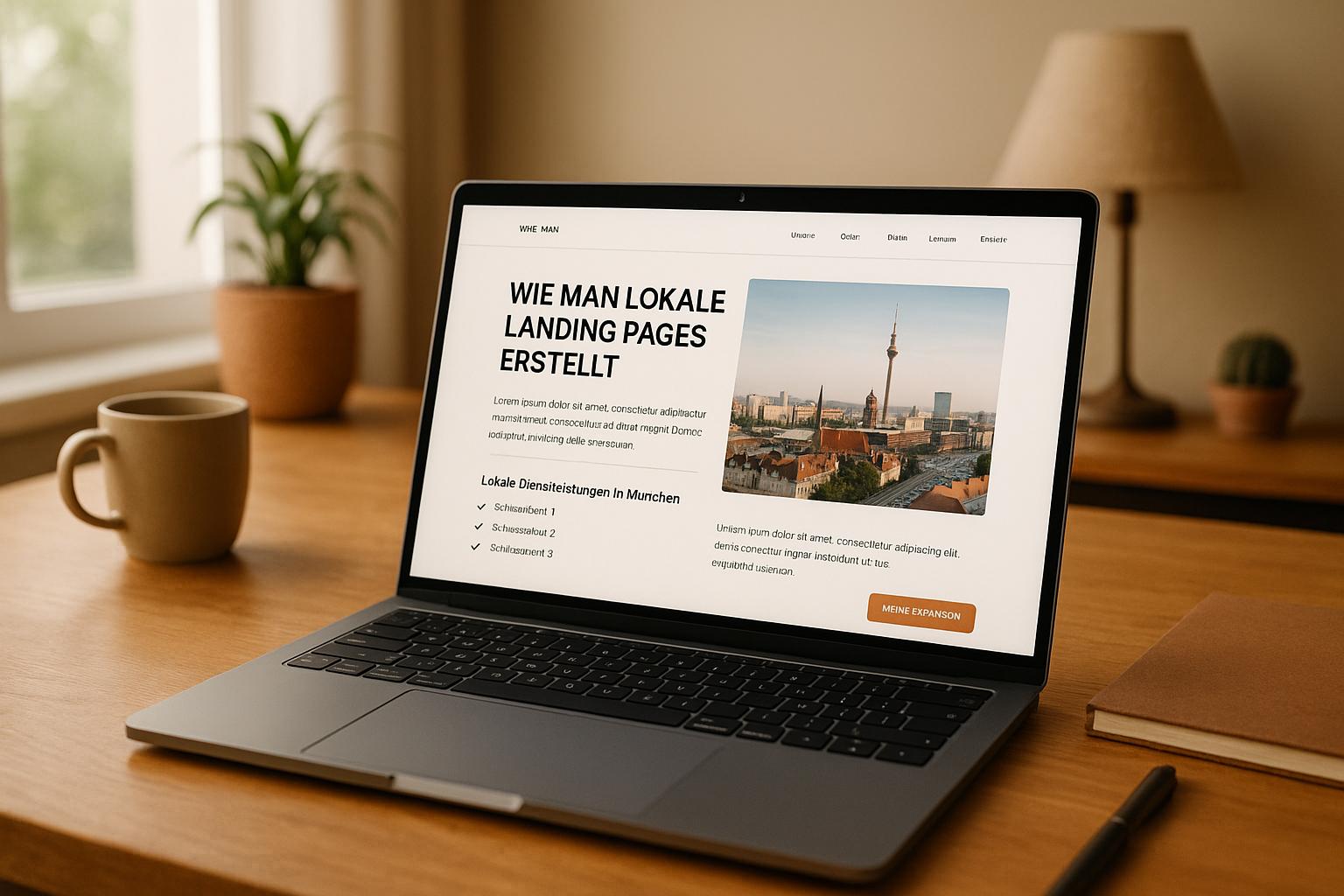
Local landing pages are decisive for addressing customers in specific regions in a targeted way. They combine location-based content with clear user guidance to build trust and increase the conversion rate. Companies that use these pages effectively benefit from better visibility in local search results and stronger customer loyalty.
Table of contents 11 sections
- 01Build legendary local landing pages (guide + example)
- 02Core elements of a local landing page
- 03Step-by-step guide for building a local landing page
- 04Design for local relevance and user experience
- 05Tools and strategies for implementation
- 06Conclusion and key takeaways
- 07FAQs
- 08NAP data: why they are important for local landing pages
- 09How to make your local landing page GDPR-compliant
- 10Why localised content is decisive
- 11Related posts
Core points for successful local landing pages:
- NAP data (name, address, phone number): must be consistent and correct.
- Google Maps integration: shows location and directions.
- Opening hours and contact options: clearly visible and up to date, including local payment methods.
- Localised content: copy, images and offers should be regionally adapted.
- Call-to-actions (CTAs): specific and action-oriented, e.g. "Book appointment in Hamburg".
- Technical details: fast load times, mobile optimisation and schema markup for better findability.
Important tools:
- Elementor (from €59.00/year): ideal for WordPress users.
- GetResponse (from €15.00/month): offers unlimited landing pages.
- HubSpot (free plan available): integrates CRM and SEO tools.
Local landing pages are more than just translated content - they require precise planning, technical know-how and a clear focus on regional needs. With the right strategy, companies can strengthen their online presence and achieve measurable success.
Build legendary local landing pages (guide + example)
Core elements of a local landing page
A successful local landing page combines several important building blocks that strengthen user trust and increase the conversion rate. According to studies, 78% of consumers search online at least once a week for information about local businesses. With the right mix of these elements, conversion rates can be increased by 25% or more.
Important features for local pages
NAP information (name, address, phone number) is the backbone of every local landing page. This data must appear consistently and correctly across all listings. Google Maps integration is indispensable. Companies such as REI rely on location-based landing pages that include address, opening hours and an interactive map. Such a map should show the exact location along with directions. Opening hours should always be clearly visible and up to date. Visionworks, for example, shows not only opening hours but also addresses, directions and references to nearby facilities such as shopping centres or schools. In Germany the 24-hour format is recommended, e.g. 09:00-18:00. Local contact options extend the basic data with useful functions such as click-to-call buttons for mobile users or messaging services like WhatsApp Business. German companies should also address regional payment methods such as SEPA direct debit, PayPal or purchase on invoice.
After the technical basis comes the content - decisive for trust and engagement.
Localised content for stronger loyalty
Technical optimisation is the start, but localised content creates a deeper connection with users.
Region-specific content triggers emotional resonance. Luxe Hair Salon in Phoenix, Arizona, specifically highlights the region in its copy and offers exclusive deals for local customers. Customer reviews are equally important: Park West Dental Care in Idaho Falls integrates them directly on the landing page. In Germany, companies should prominently display reviews from platforms such as Google, Trustpilot or local portals. Trust-building elements such as certificates, seals of approval or memberships give a professional impression. TÜV seals, IHK memberships or industry-specific certificates are particularly effective in Germany. Photos of the team and premises create a personal connection. Firehook Bakery in Washington, DC, shows alongside NAP data and a map also pictures of the team and the business premises. Such authentic insights strengthen user trust.
Call-to-actions and interaction
All the elements mentioned above should encourage users to take action in a targeted way. Local, specific call-to-actions (CTAs) such as "Book appointment in Munich" or "Request free consultation in Hamburg" are often more effective than generic wording.
Online appointment bookings are now a standard. Honest-1 Auto Care in Portland, Oregon, uses location-specific landing pages combining NAP data, reviews and special offers. German companies can use tools such as Calendly, Doctolib or industry-specific solutions. Social media links should point to local profiles. A restaurant in Munich could, for example, link directly to a location-specific Instagram account to emphasise the local connection. Structured data (schema markup) is a technical key to better findability. It helps improve visibility in local search results.
"Schema is like a signpost for Google. It may seem inconspicuous, but it ensures your pages show up in the right search results. At ClockShark, we always use LocalBusiness schema, and for service-related pages we add Service schema to highlight our offers. That increases visibility in voice searches and mobile map results." - Luke Chapman, Senior SEO Strategist at ClockShark
Step-by-step guide for building a local landing page
If you want to build a local landing page, you should take a structured approach - from planning to optimisation. This guide shows how to master the entire process.
Define goals and audience
Before you start, you should know who you want to address and what you want to achieve.
A thorough analysis of your audience is the first step. Tools such as Google Analytics or customer surveys help you understand the demographic and psychographic characteristics of your potential customers. Two central questions are decisive: where should your visitors come from? And where do your current local visitors come from?
Segmenting your audience by relevant criteria makes your strategy more targeted. Split your audience into smaller groups - based on age, interests or behaviour. For example, a gym could distinguish between younger sports enthusiasts and older people focused on health training.
Also take regional particularities such as gender, age and income level into account. A luxury spa in Munich has different requirements than a trade business in a small town.
Set measurable goals to align your landing page effectively. Instead of vague wording such as "more enquiries", you should aim for concrete numbers, e.g. "25 appointment bookings per week via the landing page by 31.03.2025".
With clear goals and a clearly defined audience, you can now choose the right platform.
Choose the right platform or tool
The choice of platform influences how flexible and scalable your landing page becomes.
With WordPress and plugins such as Elementor or SeedProd, you can create responsive designs that look good on all devices. These tools also allow integration of Google Maps, local schema markups and multilingual content.
Alternatively, specialised solutions such as Unbounce or Leadpages offer prebuilt templates specifically designed for conversion optimisation. They include features such as A/B tests and detailed analytics.
Remember to keep German date and number formats and GDPR-compliant data processing in mind. Integration with existing systems - such as CRM, email marketing or booking tools - can save you a lot of time.
Once your platform is in place, the design is next.
Create a user-friendly layout
The layout of your landing page influences how well visitors interact with the content and whether they take the desired actions.
A mobile-first design is particularly important in Germany. Start with the smartphone view and then adapt the design for larger screens. Make sure all interactive elements are easily accessible and simple to use.
A clear visual hierarchy and intuitive navigation help guide visitors through the content in a targeted way. Place the most important information - such as contact details, your offer and the call-to-action - clearly visible. Areas such as "Contact", "Opening hours" and "Directions" should be easy to reach, e.g. via a sticky header.
Optimise the load time of your page. Google favours pages that load in less than 3 seconds. Use image compression, caching and hosting providers with servers in the DACH region to ensure fast load times.
Localise content and design
For your landing page to resonate with your audience, you should adapt content and design to the language and expectations of your target group.
German texts are often longer than their English counterparts - sometimes by up to 35%. Use flexible text fields and test your layouts with longer German sample texts to make sure everything looks good.
Cultural adjustments are also important. German consumers place great value on security. 82% read the terms and conditions before ordering online. Therefore, make privacy policy, imprint and terms visible.
Also offer preferred payment methods such as PayPal, purchase on invoice or SEPA transfers. 87% of Germans prefer home delivery, which you should consider when designing your offers.
Strengthen the regional connection through local references and wording. Use location-specific call-to-actions such as "Book an appointment in Berlin now" or "Request a free consultation in Stuttgart". Avoid symbols or terms that seem more American, unless they are relevant for your offer.
Design for local relevance and user experience
After the content has been carefully adapted, design plays the next central role. A landing page should not only be translated but also designed so it feels authentic. This is achieved through targeted design decisions that meet regional expectations while providing a user-friendly experience. Design complements the content and makes sure the page resonates with users.
Include local visual elements
Images that create local connections foster identification. German users feel addressed by familiar surroundings and everyday situations.
- Local landmarks or typical landscapes: a restaurant in Munich could show an Alpine panorama, while a Hamburg company could use maritime motifs.
- People in authentic scenarios: scenes such as shopping at the weekly market, working in a typical German office or regional leisure activities create proximity.
- Colour schemes and symbols: adapt the colour world to your brand and the region. A company from northern Germany could use blue and green tones, while in Bavaria warm earth tones are popular. Symbols should be clear and understandable, such as a phone receiver for contact or a calendar for appointments.
Germans prefer structured layouts without overloaded design elements. Clear typography, ample whitespace and intuitive design help the page appear professional and inviting.
Accessibility and usability
An appealing design alone is not enough - the page must also be accessible to all users. Accessibility in Germany is not only an expectation but also required by law through the Accessibility Strengthening Act (BFSG). Compliance with WCAG 2.1 Level AA standards is a must.
"Inclusive design is not about disability, it's about usability. When we design for the extremes, we make the experience better for everyone."
- Place contact information visibly: German users expect complete details such as company name, address, phone number, email and business hours. These should be clearly visible in the header or footer and marked up with structured data so that search engines can interpret them correctly.
- Provide directions: integrate Google Maps with the exact address and offer a text description of how to get there - including information on public transport, since many Germans use public transport.
- Ensure technical accessibility: the page should be navigable by keyboard, offer sufficient colour contrasts and contain alt texts for images. Regular tests are essential to address potential issues early.
Regional formatting and adjustments
Correct formatting shows that you understand your audience's needs. Incorrect displays, on the other hand, can come across as unprofessional and damage user trust.
Studies show that 65% of consumers prefer to use websites in their own language, even if the content is not perfect. 40% avoid purchases on sites in a foreign language entirely.
| Element | German format | Example | | Currency | EUR with comma as decimal separator | €2,500.50 | | Date | DD.MM.YYYY | 15.08.2025 | | Numbers | Full stop as thousands separator (in German locale: dot) | 10,000.50 | | Time | 24-hour format | 14:30 | | Temperature | Celsius | 22 °C |
- Technical implementation: use the HTML attribute to mark the page correctly and save dates in ISO 8601 format so they can be displayed accordingly later.
- Ordinal numbers: in German, "am 14. August 2025" is used instead of "am 14 August 2025".
- Use metric units: give distances in kilometres (e.g. "5 km from the city centre") and areas in square metres (m²). Temperatures should be given in degrees Celsius.
These details build trust and show that you take the expectations of your German audience seriously. A correctly formatted and user-friendly landing page comes across as professional and leaves a positive impression - qualities German users particularly appreciate.
Tools and strategies for implementation
The choice of the right tools is decisive when it comes to effectively implementing the described design and localisation strategies. With landing page builders offering drag-and-drop editors, customisable templates and integrated forms, conversion-optimised pages can be created quickly. Many of these tools integrate easily with email marketing, CRM and ad platforms to manage leads better and simplify tracking. Here are some proven options:
Recommended tools for local landing pages
Landingi offers an AI-powered platform with over 400 templates that integrates seamlessly with CRMs and email marketing services. It supports multilingual content and local formatting. The free plan is limited, paid options start at €29.00/month.
Elementor provides a drag-and-drop editor with live editing, over 300 designer templates and a responsive design. With features like a custom theme builder and WooCommerce integration, it is particularly suited for WordPress users. Prices start at €59.00/year (Lite plan), while the Basic plan costs €99.00/year. For larger requirements there are Business and Grow plans at €199.00/year each. GetResponse is a comprehensive marketing solution with dynamic templates, A/B testing and social media integrations. It offers unlimited landing pages and an automatic plan upgrade after 1,000 page views. Entry price is €15.00/month. HubSpot Marketing Hub combines email marketing automation, lead management and reporting with smart SEO tools and A/B testing. It offers a free plan, while the Starter plan begins at €20.00/month. For advanced features, the Professional plan costs €890.00/month and the Enterprise plan €3,600.00/month.
Criteria for tool selection
When choosing a landing page builder, you should pay attention to aspects such as usability, customisation options, integration options and costs. For German companies in particular, GDPR compliance, local payment methods and German-language support are important factors. Use free trials or demos to test the software beforehand. The monthly costs for AI-powered tools vary between €10.00 and €200.00 depending on feature scope.
For small and medium enterprises in Germany, additional criteria such as integration with existing CRM systems (e.g. Salesforce or HubSpot), multilingual support and local payment processing (e.g. SEPA or PayPal) are decisive. Also, a responsive design is indispensable since many German users access websites via mobile devices.
Comparison table for tools
The following table summarises the key features of the tools:
| Tool | Starting price | Special strengths | Limitations | Reviews | | Landingi | €29.00/month | AI-powered, 400+ templates | Limited customisation in free plan | 2 reviews | | Elementor | €59.00/year | WordPress integration, 300+ templates | Requires WordPress knowledge | 12 reviews | | GetResponse | €15.00/month | Complete solution, unlimited landing pages | Automatic upgrade after 1K views | 1,428 reviews | | HubSpot | Free | CRM, advanced automation | High cost for Pro/Enterprise | 18 reviews | | Leadpages | €25.00/month | Simple user interface, low price | Limited customisation options | 11 reviews | | Unbounce | €79.00/month | Conversion-oriented templates, A/B testing | More complex user interface | 2 reviews |
The choice of the right tool depends on your individual requirements. While smaller companies often benefit from GetResponse or Leadpages, tools such as HubSpot or Elementor are ideal for larger companies with more complex needs.
Conclusion and key takeaways
Local landing pages are far more than just translated content - they combine UX, SEO and compliance into an effective unit. Adriana Stein from AS Marketing Agency Hamburg puts it in a nutshell:
"Localisation is not just translation - it covers UX, SEO and compliance."
This comprehensive approach distinguishes an average page from one that really converts.
Statistics underline the importance: 76% of consumers prefer to buy on websites in their mother tongue. In Germany, 55% of online buyers go as far as shopping exclusively in their mother tongue. This shows how decisive a thoughtful localisation is for business success.
Steps and proven practices for local landing pages
A systematic approach is the key to successfully creating local landing pages. It all starts with a thorough analysis of the market and the audience. Particularly important: local keywords such as "search engine optimisation Hamburg" or "SEO agency Berlin" that reflect the search behaviour of German users.
The technical implementation also plays a central role. Consistent NAP data (name, address, phone number) and schema markup significantly improve visibility in local search. Example: after a law firm in Milwaukee corrected their NAP data, their local search visibility rose by an impressive 37%.
In design and user experience, German preferences should be front and centre. Trust is decisive: 82% of German consumers read the terms and conditions before a purchase. It is therefore advisable to use the formal address "Sie" and to include German case studies and customer reviews. Continuous optimisation through A/B tests must not be missing. Jazz Su of Shewin points out:
"Pages with location-specific schema markup and customer reviews from that region typically show 45% higher engagement rates."
First practical steps
Implementation starts with choosing a suitable tool. Smaller companies can go for cost-effective solutions, while larger platforms offer more comprehensive features for larger projects.
Start small - first focus on one region or city in Germany. Use local directories and watch trends with tools such as Google Trends or browse German online forums.
If the process seems too complex, it is worth working with experts. A specialised online marketing agency can not only save time but also ensure that important aspects such as GDPR compliance are maintained.
The German market, as Europe's largest economy, offers enormous opportunities. Companies that invest in a well-thought-out localisation strategy can establish themselves successfully here long term.
FAQs
Why are NAP data (name, address, phone number) so important for local landing pages and what should you look for?
NAP data: why they are important for local landing pages
NAP data play a decisive role in the success of your local landing pages. They help search engines like Google verify the correctness of your company information so users receive reliable data.
Consistency is the key: if your NAP data match on your website, in online directories and on social media channels, this not only increases your credibility but can also improve your local visibility in search engines. But beware: divergent or incorrect information can cause confusion and negatively affect your ranking.
Regularly check that your NAP data are correct and consistent everywhere. That way you strengthen the trust of your audience and remain reliable for search engines too.
How do I ensure my local landing page is GDPR-compliant?
How to make your local landing page GDPR-compliant
If you want to ensure that your local landing page meets GDPR requirements, pay attention to the following points:
- Clear privacy policy: your privacy policy must be easily accessible and, in understandable language, explain all details of data collection and processing. Transparency is paramount here.
- User consent: use checkboxes, for example on newsletter signups or contact forms. That way users can actively give their consent to the processing of their data.
- Secure data transfer: protect visitor data by using HTTPS encryption. That ensures secure transfer and strengthens trust.
It is important to review your landing page regularly, as legal requirements can change. If you are uncertain, it is best to seek professional support to stay legally safe.
How can localised content improve the conversion rate of my landing page?
Why localised content is decisive
Localised content specifically addresses the cultural, linguistic and regional particularities of your audience. That makes visitors feel immediately better understood and build trust faster - a decisive factor to significantly raise the likelihood of conversions.
Indeed, studies show that localised content can raise the conversion rate by up to 20%. By including regional terms, using local currencies such as the euro (€) or addressing specific cultural particularities, a more personal approach emerges that not only engages your audience but also convinces.