Why Priorities Paralyse Companies | Nordsteg #15
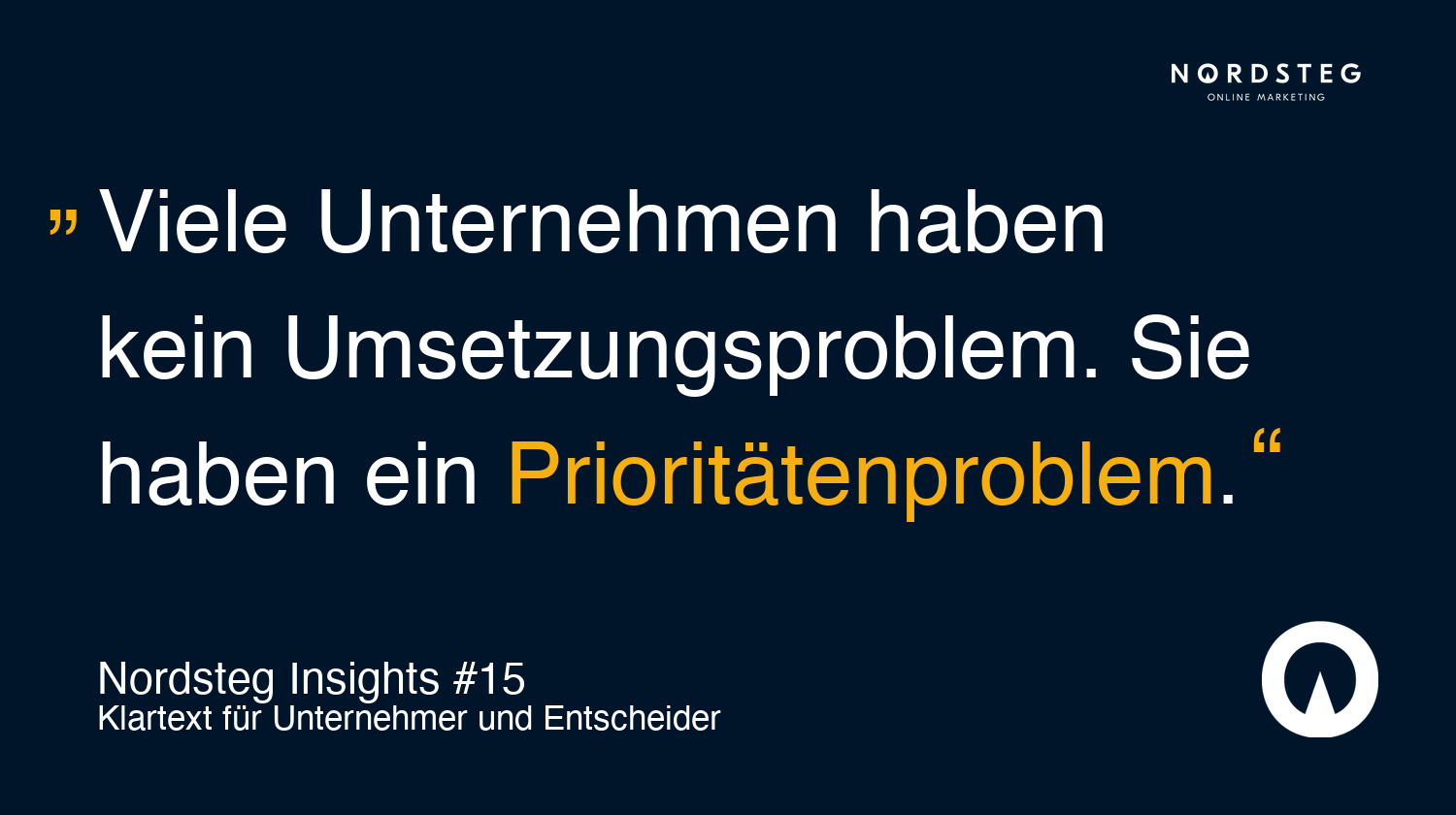
Many companies do not have an execution problem. They have a priorities problem. Or more precisely: they have too many. Everything is important. Everything has a deadline. Everything needs attention. And that is exactly why too little happens.
Table of contents 5 sections
The problem with priority lists
Priority lists are considered a leadership instrument. In practice, they are often the opposite. Because what many call 'prioritisation' is only postponement with structure: project A is important, project B too, project C actually even more so. In the end, everything stays at the top. And nothing is decided.
The typical symptoms
Teams work in parallel on too many topics, decisions are postponed, focus changes weekly, progress feels like movement - not like impact. Operationally, activity arises. Strategically, standstill arises.
Because priorities without consequence are not leadership. They are moderation.
Why prioritisation fails
Priorities do not fail because of discipline. They fail because of missing decision logic. In many organisations, it is unclear: who decides what is more important? By which principle? What is consciously not done? So everything stays open. No one wants to decide wrongly. So no one decides at all. Many CEOs react with tools: top 3 priorities, quarterly goals, OKRs without context. The problem: without clear decision rules, these lists also become political. Then it applies: the loudest wins, the most urgent crowds out the most important, the operational eats the strategic.
The other approach
Mature organisations think about prioritisation differently. Not: what else do we do? But: what do we consciously leave aside? Real prioritisation needs three things: a clear vision, decision principles, and consequence. Only then does focus arise. Not through lists - but through renunciation.
Many leaders avoid hard priorities because they trigger conflicts. But that is exactly leadership: clarifying expectations, enduring disappointment, putting direction before harmony. Focus is no team tool. Focus is a leadership decision.
The conclusion
If your company works a lot but progresses little, that rarely lies in motivation or talent. Often it lies in the fact that no one decides what really counts. Because clarity does not arise through more priorities. It arises through fewer.
Nicolas Fabjan - Founder & CEO Nordsteg
Plain talk on systems, marketing and the future.