The Future of Online Marketing in the DACH Region: What Entrepreneurs Should Watch Now
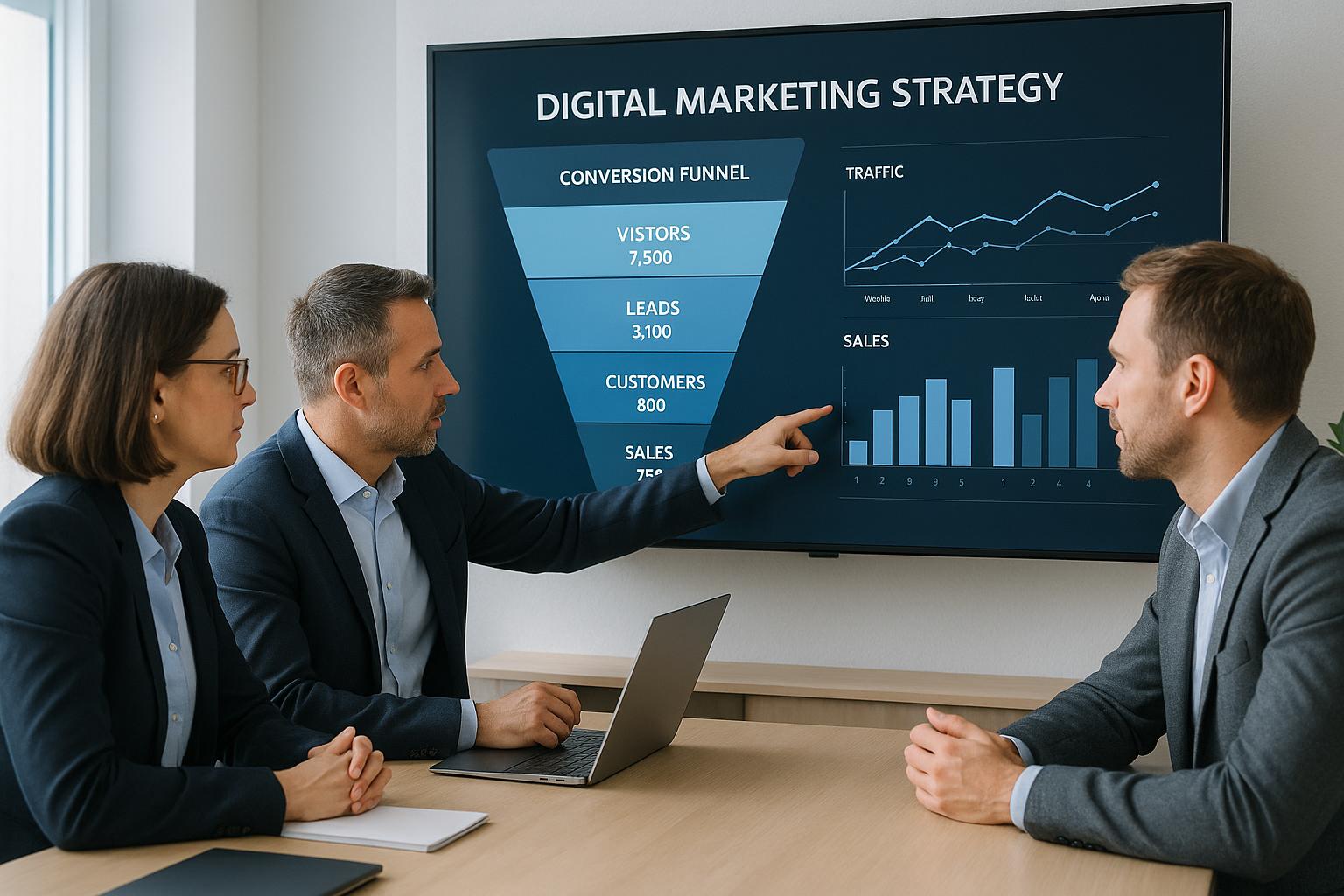
If your online marketing is not gaining traction, the reason is often a missing strategy. Many entrepreneurs invest between €1,000 and €3,000 per month in Google Ads, SEO or funnels - but without a clear plan, the budget quickly fizzles out. In the DACH region, especially in Austria, data protection, first-party data and trust are in focus. What you can do immediately:
Table of contents 6 sections
- Develop a marketing master plan that aligns all channels towards one goal.
- Use AI tools such as Performance Max, but only with clean tracking and clearly defined audiences.
- Optimise your local presence (e.g. Google My Business) and rely on first-party data.
Conclusion: anyone who wants to succeed in 2025 needs a thoughtful roadmap rather than investing randomly in tools or campaigns. Read on to learn how to plan and implement your marketing sustainably.
Why every company first needs a marketing master plan
Many entrepreneurs start marketing without a clear strategy. Often they begin directly with Google Ads, hire a SEO agency or build a funnel - all without prior alignment. The result? Budgets are used inefficiently, and the results often lag behind expectations. To avoid such problems, a strategic framework is indispensable.
A well-thought-out master plan is the key to sustainable success. At Nordsteg, we start exactly here: first we develop a comprehensive plan or roadmap before we execute concrete campaigns.
The difference is clear: companies that proceed strategically achieve measurably better results with the same budget. Why? Because all measures are aligned towards a common goal and the various channels are optimally interlocked.
What belongs in a marketing master plan
An effective master plan starts with a precise audience analysis. Only if you know your customers exactly can you direct your measures specifically. Add clear budget priorities and measurable KPIs - especially important if you take data protection and customer trust in the Austrian market into account.
Another central point is budget distribution. Instead of spreading the marketing budget evenly across all channels, a good plan sets clear priorities. A larger portion of the budget should flow into channels where the audience actively seeks solutions, while other areas such as SEO and conversion optimisation provide support.
Clear priorities help reduce complexity and act with purpose. The master plan defines which steps are carried out in which order - from the technical basis through tracking to campaign optimisation.
Another important component is success measurement. The plan sets concrete KPIs and milestones that make the success of the strategy measurable. That way you always keep track of performance and avoid nasty surprises at the end of the month. Instead of running experiments, you rely on a strategic approach that offers security and transparency.
How strategy-based marketing delivers better results
One of the biggest advantages of a marketing master plan is avoiding expensive experiments. Many entrepreneurs try different approaches in parallel - Google Ads here, Facebook Ads there, and in between a new funnel. That often leads to budgets being fragmented and no measure receiving the attention it needs to really succeed.
A strategic plan ensures that all activities are aligned with each other. One example: an Austrian B2B service provider was able, through focusing on a marketing roadmap, to significantly raise the number of qualified leads at the same budget.
Synergies between channels emerge when all measures are strategically aligned. SEO-optimised content can, for example, improve the performance of Google Ads, while insights from audience analysis feed into funnel optimisation. Uniform tracking measures ensure all channels are analysed on the same data basis.
At Nordsteg, we combine this strategic basis with continuous marketing coaching. That way no isolated campaigns emerge, but a cohesive system that is continuously optimised. Entrepreneurs not only benefit from the execution but also gain the knowledge to remain successful long term.
A marketing master plan also offers planning certainty for the entire business year. Instead of reconsidering every month which measures are sensible, you follow a clear roadmap. That saves time, reduces stress and ensures consistent results.
Top online marketing trends for 2025
In 2025, some significant changes are due in online marketing that are of particular relevance to companies in the DACH region. These trends not only shape future marketing strategies but should already feed into your planning today. Companies that want to succeed long term rely on a clearly structured marketing master plan that takes these developments specifically into account. In what follows, we show how you can sensibly integrate such trends into your strategy.
AI tools for more effective campaigns
Artificial intelligence (AI) is increasingly becoming the heart of modern marketing campaigns. Tools such as Google Ads Performance Max offer clear advantages over classic campaign types. But the key to success lies in preparation: you must first define your audiences precisely, create engaging creatives and implement reliable tracking. Only then can the AI unfold its full potential.
AI-powered campaigns take over tasks such as bid optimisation and react flexibly to audience signals. Thanks to the analysis of countless data points in real time, campaign elements can be continuously and precisely adjusted. The decisive factor: the quality of your first-party data. This data basis should be considered in your master plan from the start to maximise performance.
Local search and voice search in focus
User search habits are continuously changing, especially when looking for local service providers. In the German-speaking region, voice search is becoming ever more important. Instead of keyword queries like "tax advisor Vienna", customers increasingly use natural speech patterns such as: "Where do I find a good tax advisor near me?". This development requires an adjustment of your content strategy and targeted measures in local search engine optimisation (SEO).
A central building block here is Google My Business. Companies that actively shape their local presence benefit from a uniform display of their contact data - name, address and phone number should be consistent across all platforms. Regular updates, customer reviews and the targeted use of regional search terms contribute to sustainably strengthening local visibility.
Data protection and first-party data as the new basis
With GDPR and stricter data protection rules, online marketing has fundamentally changed. Third-party cookies are losing importance, while first-party data is increasingly taking centre stage. This development requires a conscious handling of customer data that creates trust and offers real added value at the same time.
Successful strategies go beyond pure discount campaigns. They rely on high-quality content, exclusive insights or personalised recommendations to convince customers to share their data voluntarily. Transparency and clear communication are indispensable here.
Another important task is consent management. Modern tools help steer consent in a targeted way while improving the user experience. Through the integration of first-party data from various sources - such as CRM systems, website interactions or email marketing - a comprehensive customer profile emerges. This serves as the basis for precise and effective campaigns.
At Nordsteg, we attach great importance to integrating such data strategies into our marketing master plan from the outset. That way we avoid isolated data silos and create a networked system that continuously delivers valuable insights and forms the basis for sustainable success.
Google Ads management for Austrian companies
Also in 2025, Google Ads remains an indispensable tool for companies in Austria to win new customers. But success depends on a well-thought-out strategy. A clearly defined marketing master plan helps to avoid expensive mistakes.
This master plan should precisely define audiences, budget and KPIs. Only on this basis can the various campaign types be used effectively and ad spend be managed sensibly. In what follows, you will learn how to implement these strategic steps optimally.
Determining the right campaign types and budgets
The choice of the right campaign type depends on your business goals and the available budget. For Austrian companies with an ad budget between €1,000 and €3,000, a targeted split across several campaign types is recommended.
- Search campaigns: these usually form the heart of a successful Google Ads strategy. They reach users actively searching for your products or services. Especially for local companies in Austria, regional search terms such as "tax advisor Vienna" or "dentist Salzburg" are decisive.
- Performance Max campaigns: these use Google's AI to automatically determine the best ad placements. However, success requires high-quality product data and engaging creatives. In addition, at least 20-30 conversions per month should be achieved for the campaign to work effectively.
- Display campaigns: these are excellent for building brand awareness and for remarketing. Particularly in Austria, where trust and recognition play a major role, display campaigns can significantly improve the results of search campaigns.
The budget should be split strategically: most flows into search campaigns, while Performance Max and display campaigns cover the rest. At the same time, the budget distribution should remain flexible and be regularly adjusted to performance.
Precise tracking and success measurement
A clear campaign structure alone is not enough - without precise tracking, success remains invisible. Many Austrian companies unnecessarily lose money because they do not know which measures actually bring in customers.
The first step is correctly set up conversion tracking. Define exactly which actions are valuable for your company - whether a purchase in the online shop, an enquiry via the contact form or a call via the website. These actions should be given a clear value. If an enquiry on average leads to an order of €2,500, you should reflect that value in your tracking.
To also obtain meaningful data under limited cookie consent, rely on consent management tools. Combined with Google Analytics 4 and Google Tag Manager, you can thus gain valuable insights even under difficult conditions.
Regular measurement of results should go beyond simple click and impression data. For Austrian companies, KPIs such as cost-per-acquisition (CPA), return on ad spend (ROAS) and customer lifetime value (CLV) are particularly relevant. A ROAS of 4:1 means, for example, that every euro invested brings in four euros of revenue - a good value for many industries.
Weekly reports help not only to analyse current performance but also to recognise trends and seasonal fluctuations. Particularly in Austria, these fluctuations are often pronounced, for example due to the summer break or the pre-Christmas period.
At Nordsteg, tracking setup is part of the marketing master plan from the start. That way all relevant data sources are captured and data gaps avoided. This approach combines strategic planning with exact success measurement and ensures continuous optimisation of your campaigns. The result: predictable success instead of expensive experiments.
Developing performance funnels that foster sustainable growth
Performance funnels are the heart of successful online strategies - but without a clear roadmap they often remain ineffective. What matters is a well-thought-out strategy that plans every step of the customer journey precisely and continuously improves it.
An effective performance funnel starts with a thorough analysis of your audience and its buying behaviour. Companies in Austria with annual revenue between €300,000 and €3 million need funnels that are both efficient and scalable. Each euro invested should result in concrete, measurable outcomes.
Regional particularities play a central role: a tax advisor in Vienna and an online shop from Salzburg need different approaches to reach their audiences optimally. This individual adjustment forms the basis for all further steps in the funnel.
The first contact point - often via Google Ads or social media - is decisive for the success of the entire funnel. The landing page must convince the visitor within seconds. Trust signals such as seals of approval, customer reviews and local references are particularly important for Austrian companies.
Data-based funnel optimisation for better conversion rates
Successful optimisation is based on precise data, not guesses. For Austrian companies, KPIs such as conversion rate, cost per lead and customer lifetime value are essential.
What matters is precisely analysing where users drop out. Tools such as Google Analytics 4 and heatmap software provide valuable insights into user behaviour such as scroll depth, time on page and click paths.
Optimise in a targeted way and in small steps. Test individual elements such as headlines or call-to-actions (CTAs) systematically over a sufficiently long period to achieve reliable results. Seasonal fluctuations, which often play a big role in Austria, should always be considered.
Nordsteg's roadmap-based growth approach
Once the data reveals the weak spots in the funnel, our roadmap-based approach comes into play. At Nordsteg, we start every performance funnel with a detailed marketing roadmap that serves as a strategic foundation. This approach sets us apart from agencies that jump straight into execution.
Our marketing roadmap - a proven master plan - first defines audience, budget and expected results. Building on that, we develop the matching funnel, which takes into account not only the current situation but also the planned growth of your company.
The implementation process follows clear priorities: first the tracking setup is optimised, then the landing pages are improved, and finally the traffic sources are scaled. For this we rely on tools such as Google Analytics 4, Google Tag Manager and conversion tracking to guarantee consistent and reliable data.
Our coaching approach ensures that you as an entrepreneur understand the funnel and can evaluate it independently. Regular reports provide you with current figures, trends, optimisation potentials and concrete recommendations for action - so you always stay in control of your marketing budget.
Especially for Austrian companies with a monthly marketing budget between €1,000 and €3,000, this approach is ideal. Every euro invested is deployed strategically to achieve sustainable growth - even in economically challenging times.
Next steps for entrepreneurs
The future of online marketing in the DACH region calls for a clear plan instead of relying on short-term experiments. If you as an entrepreneur want to grow long term, now is the right time to take action.
The first and most important step is the development of a well-thought-out marketing strategy before you invest in new tools or campaigns. Even the most modern technologies are of little use without a clear direction. Your monthly marketing budget of €1,000 to €3,000 should be used in a targeted and effective way.
Start with an honest analysis of your current activities. Which channels are you already using? Where do potential customers drop out? Which data do you capture, and how do these feed into your decisions? After this inventory, define your audience and analyse its buying behaviour.
Especially in Austria, customers place great value on trust, quality and a local presence. These aspects should be reflected in your strategy - from the design of your performance funnels to the choice of the right marketing channels.
A proven approach is to first optimise your tracking, then improve your landing pages, and finally scale your traffic sources. That way you minimise risks and maximise the benefit of every euro invested.
For the successful implementation of this strategy, professional support is decisive. At Nordsteg, we develop a marketing roadmap together with you that serves as a strategic foundation. This roadmap gives you a clear plan for reaching your goals and securing sustainable growth. With our coaching approach, you stay in control of your marketing while benefiting from our expertise.
The time for strategic action has come. Companies that act with a clear plan by 2025 will be a decisive step ahead of the competition. Start planning your marketing future today.
FAQs
Why is a well-thought-out marketing master plan indispensable for companies in the DACH region, and how does Nordsteg stand out here?
A well-thought-out marketing master plan is indispensable for companies in the DACH region to secure long-term growth and hold their ground in a constantly changing market environment. Instead of engaging in short-term experiments with uncertain results, Nordsteg relies on a strategic approach geared towards sustainable success.
With a combination of clear strategy and individual coaching, Nordsteg supports companies in aligning their marketing activities in a structured way and working towards measurable results. This approach not only creates clarity but also enables predictable and continuous development - perfectly matched to companies with annual revenue between €300,000 and €3,000,000 and a monthly marketing budget between €1,000 and €3,000.
Why are first-party data and data protection decisive for a successful online marketing strategy under GDPR?
First-party data plays a decisive role in a future-proof online marketing strategy, especially under the strict requirements of GDPR. This data, collected directly from your customers, enables you to create tailored experiences and build long-term customer relationships. At the same time, it reduces dependency on third-party providers, giving you more control over your data and its use.
Data protection as a basis for trust
Handling this data responsibly is as important as collecting it. Companies must ensure that all GDPR requirements are strictly adhered to. This not only protects you from legal consequences such as fines but also strengthens customer trust in your brand. A transparent and secure handling of data is increasingly becoming a competitive advantage.
Our approach at Nordsteg
At Nordsteg, thoughtful planning always comes first. Before we implement measures, we develop a marketing master plan or a roadmap. This structured approach guarantees predictable results and sustainable growth - without relying on short-term experiments. Because only with a clear strategy that puts data protection and data quality centre stage can you succeed long term.
How can Austrian companies use AI sensibly to improve their marketing strategy and make campaigns more efficient?
Austrian companies have the opportunity to use artificial intelligence (AI) specifically to improve their marketing strategy and make campaigns more effective. Here are three approaches for using AI sensibly in marketing:
- Personalisation: with AI, content and experiences can be tailored specifically to the audience. That means you can customise offers and messages to the needs and interests of your customers - a decisive factor to stand out from competitors.
- Data analysis: AI-powered tools enable you to gain deeper insights into the behaviour and preferences of your customers. These data-based findings help you make sound decisions and optimise your marketing measures in a targeted way.
- Process automation: recurring tasks such as sending emails or running ads can be automated by AI. That way you save time and use your resources more efficiently.
Through the clever use of AI, companies can not only optimise their workflows but also secure their competitiveness long term.